


Few challenges test a business quite like Change.
During the COVID-19 period, I had the opportunity to speak with the third-generation owner of a traditional restaurant. Like many businesses at the time, they were navigating uncertainty. With dining restrictions in place, customers could no longer enjoy meals in the restaurant, and naturally, the conversation turned towards e-commerce and digital marketing.

Big change in consumer behaviour after the COVID-19 pandemic, where consumers became more receptive to ordering or purchasing online.
As we spoke, I explained that a website alone would not solve the problem. A website is merely a destination — a place where customers can learn about the business and complete a transaction. To get people there, the business still needed ways to reach, engage, and attract customers.
The owner understood and agreed. Unfortunately, when the idea was brought to his father, who remained the key decision-maker, the proposal was rejected.
The reason was simple. The business had previously experimented with social media marketing for three months without seeing encouraging results. To him, that was enough evidence to conclude that marketing simply did not work for their restaurant.

Looking back, the issue was never whether social media worked. The real question was whether the business was reading the environment around it.
At that point in time, customer behaviour had already begun to shift. Dining in was no longer an option for many consumers, takeaway became a necessity, and digital channels were increasingly becoming the bridge between businesses and customers. By shutting the door on digital exposure entirely, the restaurant was effectively limiting itself to a shrinking pool of existing customers.
What concerned me most was not the rejection itself, but the mindset behind it.
Many of us resist change because familiarity feels safe. Yet while we remain comfortable with what has worked in the past, the environment around us continues to evolve. Over time, the gap between the business and the market quietly widens, often unnoticed until the impact becomes apparent.
Understanding Market Trends and Change
This is where I often find myself thinking about one of Sun Tzu’s Five Factors (五事): Climate (天).
Traditionally, Climate referred to seasons, weather conditions, and timing. A wise general would never ignore the environment before deciding when and how to move. In business, our version of “weather” looks a little different. It comes in the form of market trends, changing consumer expectations, emerging technologies, and evolving behaviours.
The challenge is not that change happens. The challenge is failing to recognise it.
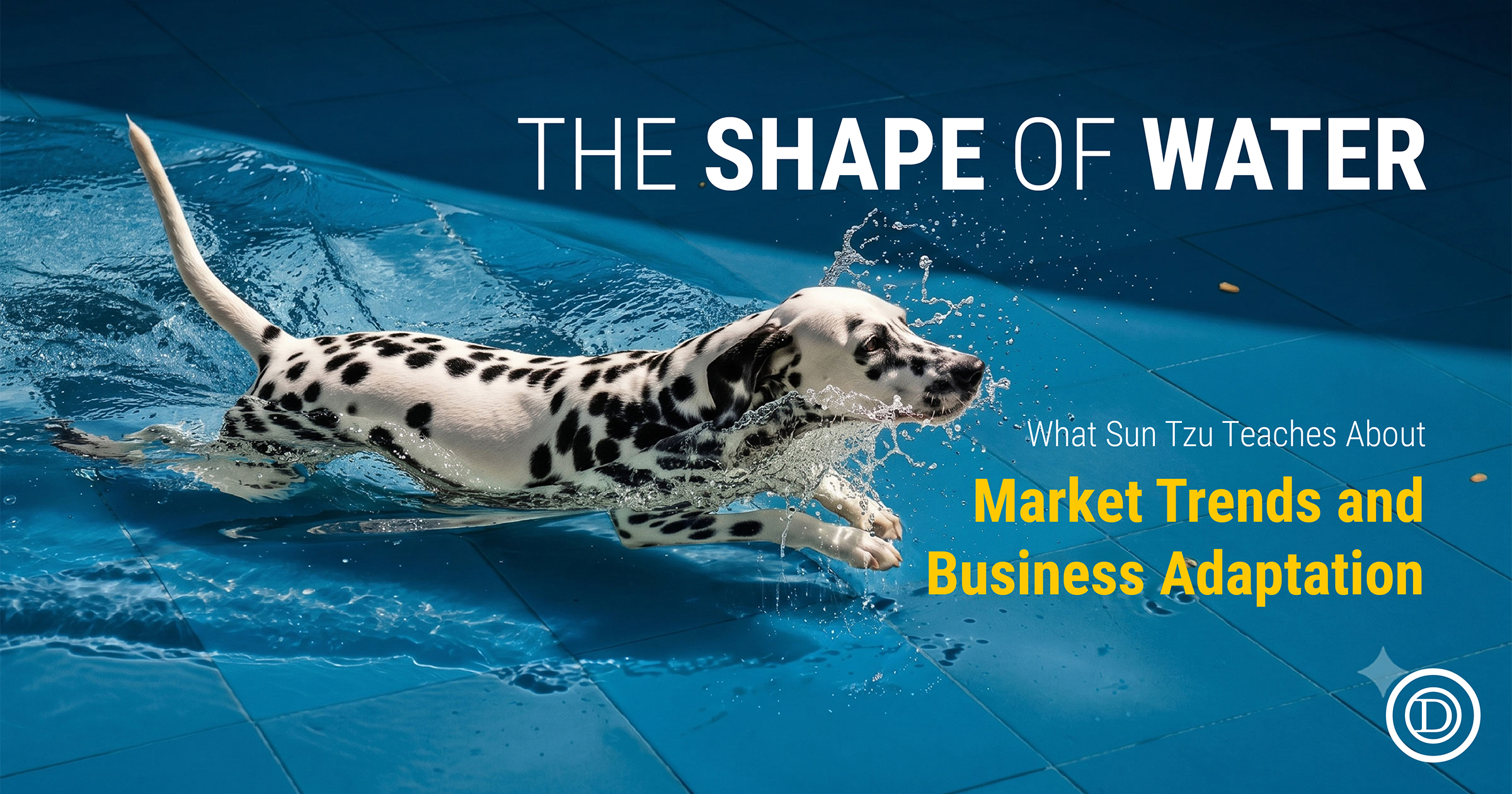
Sun Tzu captured this idea through the phrase, “故兵無常勢,水無常形” — just as water has no constant shape, there is no fixed formula in warfare.

Water changes its form when encountering obstructions. Similar to businesses, we need to be adaptive to the dynamic environment around us.
Business operates much the same way.
Markets evolve. Customer expectations shift. New technologies emerge. What worked yesterday may not necessarily work tomorrow. The organisations that remain relevant are rarely those that resist every change. More often, they are the ones who adapt thoughtfully while remaining true to their purpose.
Understanding the climate does not mean chasing every trend that appears. It simply means paying enough attention to recognise which changes matter and responding accordingly.
Adaptation Is Not Blind Adoption
Of course, adaptation should never be mistaken for impulsiveness.
Recently, I encountered a telecommunications company that attempted to embrace AI-powered customer service almost entirely. The objective was understandable — reduce manpower dependency, improve efficiency, and position itself as a technology leader.
On paper, it sounded progressive.

In reality, customers quickly became frustrated. Many complained about repetitive interactions, slow resolutions, and the inability of the chatbot to properly understand their concerns. Instead of improving the customer experience, the technology often introduced another layer of friction.
Eventually, the company was forced to rethink its approach. The fully automated system was gradually replaced with a more balanced programme that reintroduced human support alongside automation.
The technology itself was never the problem. The challenge was that the transition moved faster than customer acceptance.
Sun Tzu made a similar observation in “激水之疾,至於漂石者,勢也” — rushing water is powerful enough to move stones not because it moves quickly, but because its force is applied under the right conditions.
The lesson is not about speed. It is about suitability.
Effort becomes effective only when timing, environment, and circumstance align. The same applies to business transformation. Moving quickly may sound impressive, but if customers are not ready or their needs have not been properly understood, even the most innovative initiative can create resistance instead of results.
Change should be managed, not forced. A successful transition requires observation, refinement, and continuous adjustment to minimise negative reactions while strengthening positive outcomes.
Beyond Demographics: Understanding Consumer Behaviour
This brings us to a principle we often discuss at Dalmatian:
“Demographic is a Must, but Psychographic is always a Plus.“
Most businesses understand demographics. They know the age, gender, occupation, income level, and location of their audience. These are important because they help define who the customer is.
But demographics only tell part of the story.

Even a pair of genetic twins has different interests and thinking.
Imagine having a twin brother. You may share the same appearance, age, upbringing, and background. On paper, your demographics could be almost identical. Yet both of you may have entirely different interests, beliefs, motivations, and lifestyles.
The same applies to customers.
People who appear similar statistically may think very differently emotionally.
This is where psychographics become valuable. They help us understand behaviours, aspirations, frustrations, preferences, and decision-making patterns. While demographics tell us who the customer is, psychographics help us understand why they behave the way they do.
For branding strategy and marketing, that difference can be significant.
A business may know its audience is between 30 and 45 years old, but understanding what motivates them, what concerns them, and what they value allows the brand to communicate more meaningfully. People are naturally drawn towards brands that make them feel understood.
And in many ways, that understanding is also part of reading the climate. Trends may tell us what is changing, but behaviours often tell us why.
Staying Relevant Without Losing Your Brand Identity
One of the most enduring lessons I take from Sun Tzu is that adaptation does not require abandoning one’s identity.
Water changes shape depending on its surroundings, yet it remains water.
Likewise, businesses should evolve with changing conditions without losing sight of who they are.

Market trends will continue to shift. Consumer behaviour will continue to evolve. Technology will continue to reshape the way businesses operate. The question is not whether change will happen, but whether we are paying enough attention to respond thoughtfully when it does.
At Dalmatian, as a branding and marketing consultancy, we believe branding and marketing are not about chasing every new trend. They are about understanding which changes matter, how they affect your audience, and how your business can respond meaningfully.
Because in the end, relevance is not achieved by moving the fastest.
It is achieved by understanding the environment, understanding people, and adapting with purpose.